If you want to play Catan or any hex-based settlement game and aren't sure how it works, here's everything you need. By the end you'll be ready to sit down and play your first game with confidence.
Objective of the game
You win by reaching 10 victory points. You earn points by building settlements and cities, holding the longest road, having the largest army, and through certain development cards.
Setting up the board
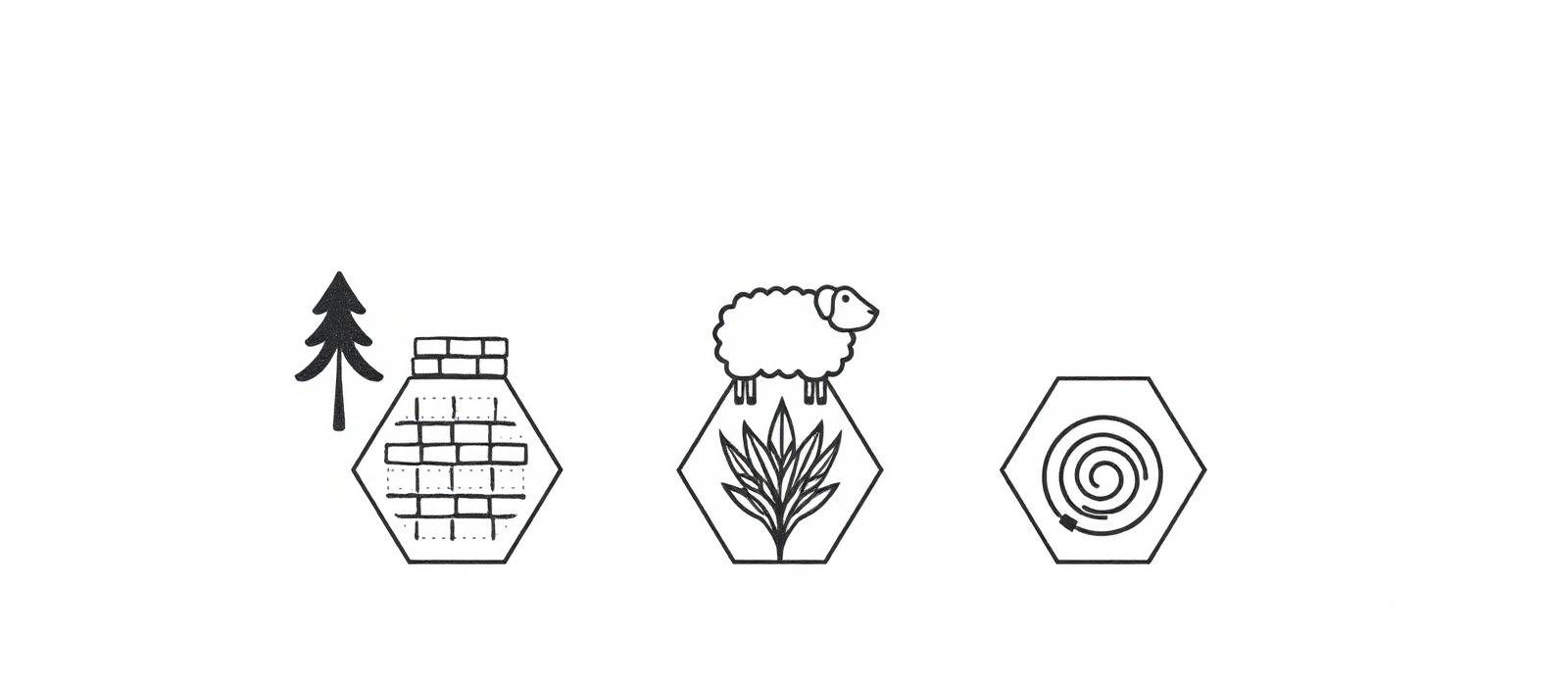
The board is made of 19 terrain hexes (forest, hills, fields, pasture, mountains, and one desert), each tied to a resource: wood, brick, wheat, wool, and ore. The desert produces nothing. Every hex except the desert carries a number from 2 to 12.
Each player places two settlements and two roads at the start, on intersections of different hexes. Your starting spots matter a lot: the more numbers and resource variety touching your settlements, the more options you'll have early on.
Turn by turn: rolling dice and collecting resources
On your turn you roll two dice. If the result matches a hex's number, every player with a settlement or city touching that hex collects the matching resource (one card per settlement, two per city).
After that you can trade with other players or the bank, and build if you have enough resources.
Building: settlements, cities, and roads
- Road: 1 wood + 1 brick. Connects your buildings and helps you expand across the board.
- Settlement: 1 wood + 1 brick + 1 wheat + 1 wool. Worth 1 victory point.
- City: built on top of an existing settlement, costs 2 wheat + 3 ore, and is worth 2 victory points instead of 1.
Settlements need a minimum distance between them, so the best board spots get taken fast.
The robber and rolling a 7
When someone rolls a 7, two things happen. First, any player holding more than 7 cards discards half of them (rounded down). Then, whoever rolled the 7 moves the robber onto a hex, blocking its production, and steals a random card from a player with a settlement or city on that hex.
The robber is the most tactical piece in the game: placed well, it can slow down whoever's in the lead.
Development cards
Bought for 1 ore + 1 wheat + 1 wool and kept face down, these include knights (which move the robber and count toward largest army), progress cards (special effects like free building or stealing resources), and hidden victory points.
Playing three or more knights earns you the largest army title, worth 2 extra points.
Longest road and largest army
Connect five or more roads in a row and you get longest road (2 points), as long as no one else has an equal or longer route. Largest army, with at least three knights played, is also worth 2 points. Both titles can change hands mid-game if another player overtakes you.
How the game is won
As soon as you reach 10 victory points (visible or hidden) on your turn, you win. Hidden points from development cards only count once you choose to reveal them, so it's worth keeping track of how many an opponent might be sitting on without you knowing.
Hexo is an independent hexagonal strategy game inspired by this genre of settlement games, with no official affiliation to Catan.
If you'd rather learn by playing than by reading, Hexo has a built-in rules assistant that answers your questions as you go: try it at /ask or check the full guide.