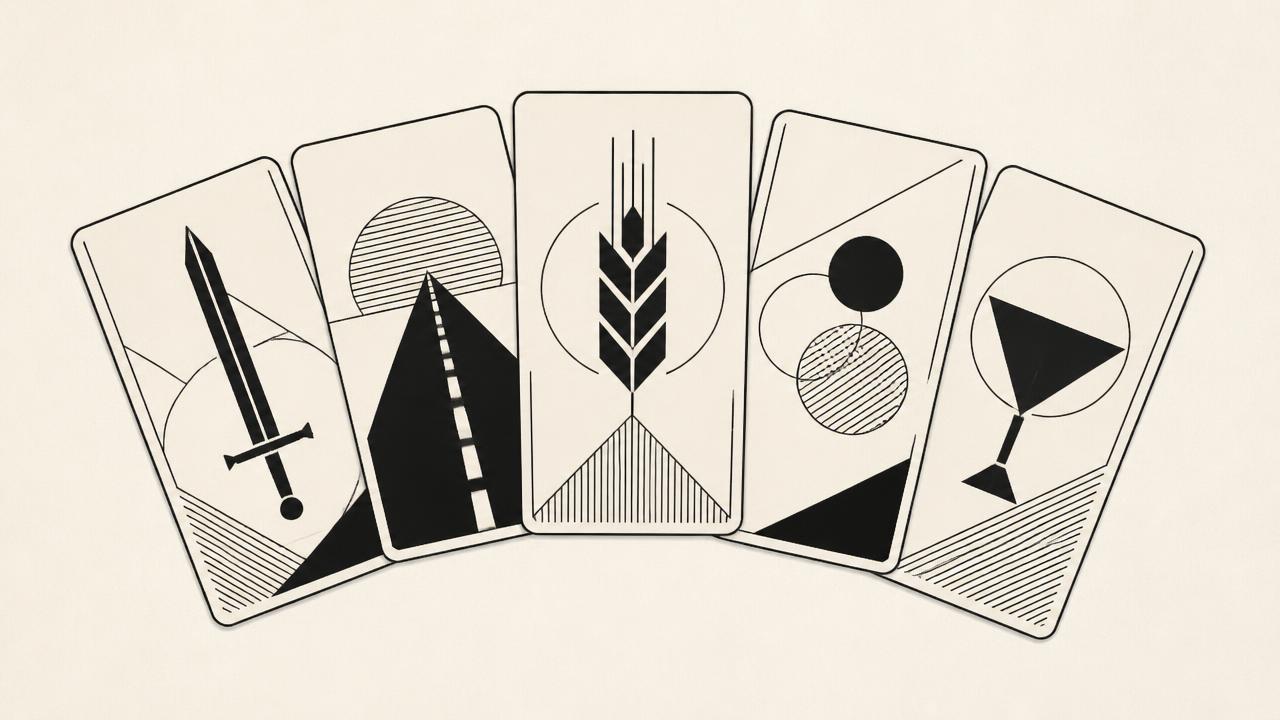
Development cards are the part of a hex strategy game where a losing position turns around. They cost the same every time — 1 ore, 1 wool, 1 grain — but their value swings wildly depending on when you buy them and, above all, when you play them.
This guide covers the five card types you'll find in Hexo, an independent hexagonal strategy game inspired by the same genre as Catan (no affiliation, no official licence), and the timing that separates a wasted card from a winning one.

How the deck works
- Buying a card costs 1 ore + 1 wool + 1 grain.
- You draw blind: you don't choose which card you get.
- A card bought this turn can't be played until your next turn (victory points are the exception — they are never "played", they just count).
- The deck is finite, so late in the game the odds shift toward whatever is left.
Knight
What it does: move the robber to any hex and steal 1 resource card from a rival with a building next to it. Each knight you play also counts toward the largest army.
When to play it: right before you need a specific resource, so the steal has a chance of hitting it. Also play knights to park the robber on the hex feeding the leader — denying a 6 or 8 for a full round is often worth more than the card you steal.
Common mistake: hoarding knights "for later". Largest army is worth 2 victory points, but only if you actually play three of them before someone else does.
Road Building
What it does: place up to 2 roads for free, no wood and no brick.
When to play it: to claim the longest road at the exact moment nobody can respond, or to reach a blocked expansion spot before a rival cuts you off. Two free roads are worth 2 wood and 2 brick — a full trade round you don't have to negotiate.
Common mistake: using it to build roads you were going to build anyway. Save it for a move that changes who owns a spot.
Year of Plenty
What it does: take any 2 resources from the bank.
When to play it: as the last two cards of a build you're one short on. It is effectively a bank trade at a 1:1 rate on any resource, including the one nobody will trade you.
Common mistake: playing it early "to have resources". Its power is precision — it should complete a city, a card purchase, or a settlement on the same turn.
Monopoly
What it does: name one resource; every rival hands you all their cards of that type.
When to play it: after a roll that just paid a resource to several players, and ideally after a 7 has forced nobody to discard. Watch what people ask for in trades — that's the resource they're stacking.
Common mistake: naming the resource you need instead of the one they hold. A monopoly on 6 bricks you can't use still starves your rivals, and often that's the better play.
Victory Point
What it does: +1 victory point, hidden until you win.
When to play it: never — it isn't played. It sits in your hand and makes you look one point further from victory than you are. If you're at 9 with a hidden point, you win the turn you can add anything at all.
Common mistake: revealing it early in conversation. Silence is the card's second ability.
A simple buying rule
Buy development cards when you have a steady ore and grain income and no immediate settlement or city to build. Cards convert a stalled turn into a lottery ticket with a floor — worst case you get a victory point, best case you get a knight that flips the board.
Try it in a real game
The fastest way to learn card timing is to play a few hands. You can start a game against the AI in Hexo with no download and no account, or read the rules in 5 minutes first if you're brand new.
Frequently asked questions
What does a development card cost?
One ore, one wool and one grain. You draw the top card of the shuffled deck, so you never choose which card you get.
Can I play a development card the same turn I buy it?
No. Cards bought this turn stay locked until your next turn. The only exception is a victory point card, which is never played at all — it simply counts toward your score.
How many development cards are in the deck?
Twenty-five: 14 knights, 5 victory points, and 2 each of Road Building, Year of Plenty and Monopoly.
How do I get the largest army?
Play three knights. The bonus is worth 2 victory points and is taken from the current holder as soon as another player plays more knights than they have.
Are development cards worth buying instead of building?
Yes when you have steady ore and grain income and no settlement or city you can place. Cards turn a stalled turn into progress with a guaranteed floor.